
NEW BOOK
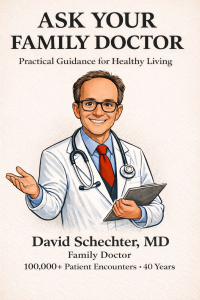
Ask Your Family Doctor: Practical Guidance for Healthy Living is a clear, practical guide to the questions patients ask every day in the doctor’s office.
Drawing on four decades of clinical experience and more than 100,000 patient encounters, David Schechter, MD offers accessible, evidence-informed guidance on prevention, healthy living, common symptoms, medications, chronic conditions, and navigating today’s healthcare system. Written in a conversational and reassuring voice, the book helps readers better understand their health, prepare for doctor visits, and make more informed decisions with their physicians.
The book begins with the foundations of an effective office visit, including patient history, physical examination, vital signs, and laboratory testing. It then explores nutrition, exercise, cancer screening, cardiac prevention, genetic testing, sleep, weight management, supplements, anti-aging, chronic pain, headaches, digestive health, respiratory infections, skin concerns, mental health, diabetes, thyroid disease, asthma/COPD, osteoporosis, hormones, medications, alternative medicine, preoperative exams, healthcare navigation, travel health, family planning, caregiver support, and end-of-life planning.
Rather than serving as a medical encyclopedia, Ask Your Family Doctor is designed to provide perspective: when to worry, when not to worry, what questions to ask, and how to become a more confident participant in your own healthcare. Each chapter includes a “Doctor’s Note” that distills the essential takeaway into practical advice readers can remember and use.
This book is intended for patients, families, caregivers, and anyone who wants a trusted physician’s perspective on everyday health decisions. It also offers useful practical insight for medical students, residents, and clinicians interested in the real-world conversations that shape primary care.
Frequently Asked Questions
Who is Ask Your Family Doctor written for? It’s written for patients, families, and caregivers — anyone who wants a trusted physician’s perspective on everyday health decisions. You don’t need any medical background to read it. It’s also a useful window into real-world primary care for medical students, residents, and clinicians interested in the conversations that actually shape a doctor’s visit.
What topics does the book cover? Quite a lot, but always in a practical way. It starts with the foundations of a good office visit — history, physical exam, vital signs, and lab testing — then moves through nutrition, exercise, cancer screening, cardiac prevention, genetic testing, sleep, weight management, supplements, anti-aging, chronic pain, headaches, digestive health, respiratory infections, skin concerns, mental health, diabetes, thyroid disease, asthma and COPD, osteoporosis, hormones, medications, alternative medicine, preoperative exams, healthcare navigation, travel health, family planning, caregiver support, and end-of-life planning.
How is this different from searching my symptoms online or reading a medical encyclopedia? An online search often leaves you with more anxiety and less clarity, and a medical encyclopedia tells you what something is without telling you what to do about it. This book is designed to give you perspective: when to worry, when not to worry, what questions to ask, and how to become a more confident participant in your own care. It’s the guidance of a physician who’s had these conversations tens of thousands of times — not a list of every possible diagnosis.
What is a “Doctor’s Note”? Each chapter ends with a “Doctor’s Note” — a short, plain-language distillation of the single most important takeaway from that chapter. It’s the practical advice I’d want you to remember and actually use, boiled down to something you can carry into your next appointment.
Can this book help me prepare for visits with my own doctor? That’s one of its main purposes. Think of it as a chance to “virtually converse” with a family doctor beforehand, so you walk into your real visit knowing which questions to ask, what information to bring, and what to expect. Prepared patients tend to get more out of their appointments — and out of their relationship with their physician.
Do I need a medical background to understand it? Not at all. It’s written in a conversational, reassuring voice meant for everyday readers. The goal is to make health information clear and usable, not to bury you in jargon.
Is the guidance evidence-derived? Yes. The book is evidence-informed, drawing on both current medical understanding and four decades of hands-on clinical experience. Where medicine is genuinely uncertain or evolving, the book says so, rather than offering false certainty.
Is this book a substitute for seeing my own doctor? No — and it isn’t meant to be. Ask Your Family Doctor is designed to help you understand your health and work more effectively with your physician. It’s a guide and a preparation tool, not a replacement for individualized medical care, diagnosis, or treatment. Always consult your own doctor about your specific situation.
Who is the author? David Schechter, MD is a board-certified family and sports medicine physician practicing in West Los Angeles, with roughly forty years of clinical experience and more than 100,000 patient encounters. The book grows directly out of the questions his patients have asked him, again and again, across that career.
When will the book be available, and how can I get a copy? Now (8/2/26) it is available on Amazon.com in paperback and kindle/ebook. Also in office in mid-August 2026. Check back on this page for updates. Hardcover expected soon (8/6), and audible as well (8/6 or so)–computer generated audio– but high quality, as well.
Updated August 2026